











Everything You Want to Know About MammaPrint


Click on the Questions Below to Learn More:

What is MammaPrint?

MammaPrint is the only FDA-cleared breast recurrence test available to patients and physicians.  Truly, a “next-generation” diagnostic test, MammaPrint leverages the advances made by the Human Genome Project and the newest developments in DNA microarray technology to analyze the underlying biology of your tumor and provide you and your physician with powerful insights into the aggressiveness of your cancer.(1-3)


How will I benefit from MammaPrint?
MammaPrint is a significant advancement towards truly personalized cancer diagnosis and treatment. When combined with other risk assessment factors, MammaPrint provides new and independent information about your risk of metastasis and can aid you and your physician in making more informed decisions about the use of hormonal therapy alone, or in conjunction with chemotherapy.
How will my doctor use the MammaPrint result for treatment decisions?
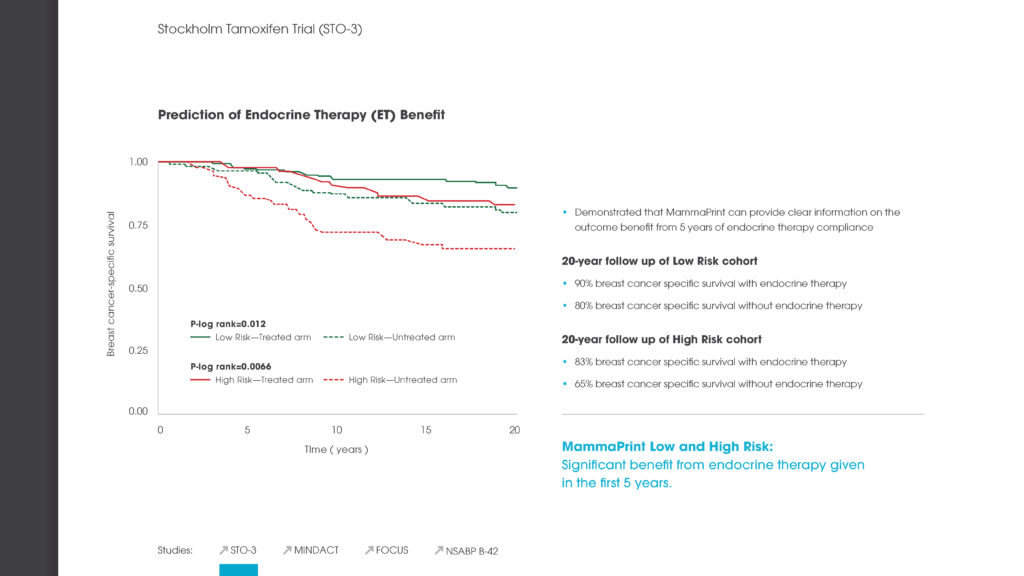
Surgeons and oncologists rely on MammaPrint along with other clinical criteria to assist in their therapeutic decision making. When combined with traditional risk factors, if you are Low Risk by MammaPrint your doctor may recommend hormonal therapy, which is believed to further reduce your risk. Conversely, if you are High Risk by MammaPrint and have additional risk variables, your doctor may recommend more aggressive therapy which may include chemotherapy.


What does the MammaPrint test result mean?

MammaPrint analyzes the 70 critical genes identified in breast cancer metastasis to determine a woman’s true risk of recurrence. MammaPrint provides a definitive result of Low Risk or High Risk of metastasis. With MammaPrint, there are no intermediate results, so there is no uncertainty about your personal risk and treatment needs.


Low Risk Result:

A “Low Risk” MammaPrint result means that a patient has a 10% chance that her cancer will recur within 10 years without any additional adjuvant treatment, either hormonal therapy or chemotherapy.(3,4)


High Risk Result:

A “High Risk” MammaPrint result means that a patient has a 29% chance that her cancer will recur within 10 years without any additional adjuvant treatment, either hormonal therapy or chemotherapy.(3,4)

How was MammaPrint developed?

As reported in the prominent scientific journal Nature, MammaPrint was developed on 10 year outcome data from an untreated breast cancer patient population providing an unbiased gene selection. With a small sample of each patient's tumor, our researchers analyzed the entire human genome. After examining approximately 25,000 genes, the most prognostic genes involved in breast cancer metastasis were discovered. Then a precise bioinformatics algorithm was used to identify the 70 gene expression signature.(1)

What is the added benefit of MammaPrint microarray technology?

MammaPrint is performed using microarray chip technology, which enables the assessment of the 70-gene signature and has the added benefit of simultaneously researching thousands of additional genes.

In addition to MammaPrint, Agendia analyzes 161 additional prognostic breast cancer genes, 56 unique drug target genes, 80 subtyping genes, 465 normalization genes and 536 quality control genes — a total of 1,368 individual genes per patient result. Although these extra genes are not currently reported, Agendia is actually documenting the unique characteristics, or “fingerprint,” of your tumor.

As the scientific and medical community gains a greater understanding of the role that these supplementary genes play in disease progression and treatment, the data captured may provide the key to an even greater level of personalized medicine for you.

How does MammaPrint differ from other laboratory tests being performed?
Only MammaPrint analyzes the 70 critical genes that influence breast tumor progression and the potential for metastasis, giving you and your physician powerful insights into the aggressiveness of your cancer. MammaPrint provides you and your doctor new and independent information distinct from traditional clinical and pathological risk assessment criteria, such as age, tumor size and hormonal (ER/PR/HER2) status.

MammaPrint has been validated through numerous peer-reviewed, published studies around the globe and by the FDA as a highly accurate means of identifying your individual risk of metastasis. MammaPrint provides a definitive result of Low Risk or High Risk of metastasis.(3-11)
How does MammaPrint differ from genetic testing?

Genetic testing refers to the study of genes and their role in inheritance, the way certain traits or conditions are passed down from one generation to the next. Whereas MammaPrint is a genomic test that measures the activity of 70 genes involved in breast cancer metastasis. It provides a genomic signature of your complex tumor biology that assesses the risk of your breast cancer returning and helps determine your need for therapy.

How was MammaPrint validated?

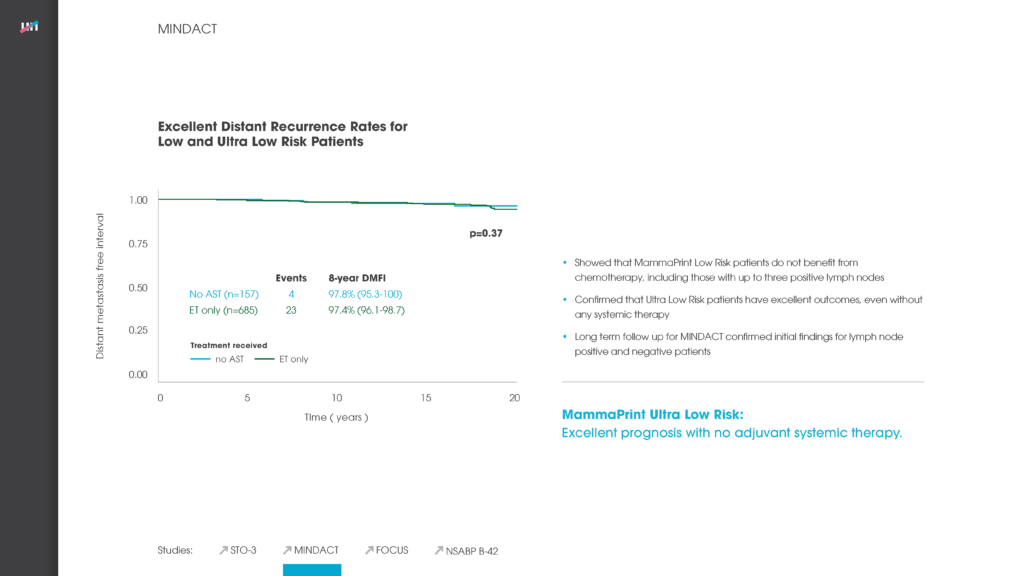
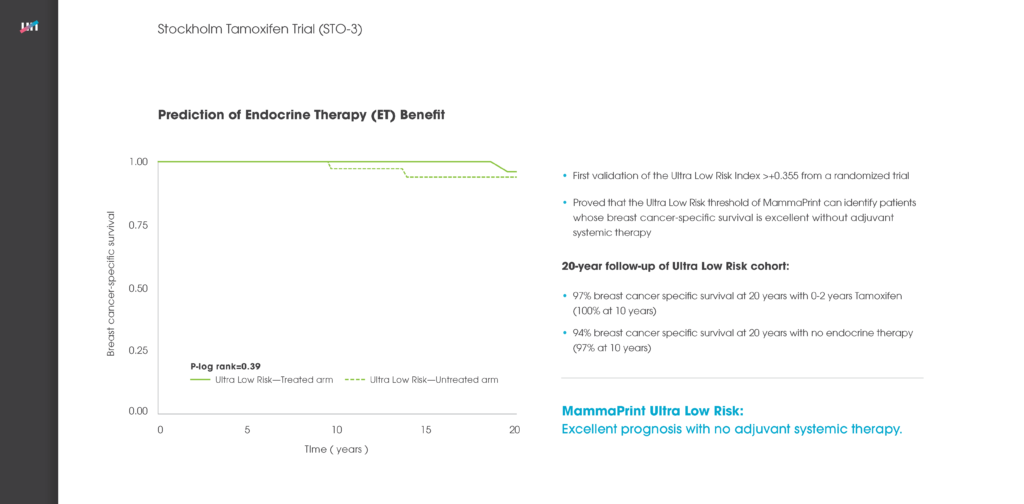
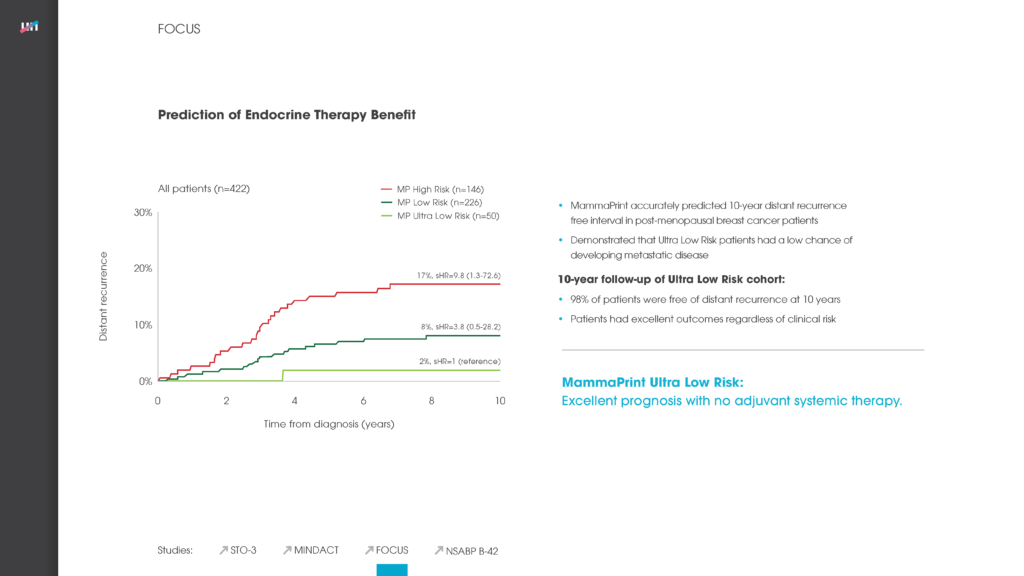
MammaPrint has been independently validated in scientific studies on over 2,375 breast cancer patients at leading US and European cancer centers, with results published in highly respected peer reviewed medical and scientific journals such as the New England Journal of Medicine, Lancet Oncology, Journal of the National Cancer Institute, Clinical Cancer Research, and Breast Cancer Research and Treatment, among others.(4-15)

To date, over 14,000 early stage breast cancer patients like you have chosen MammaPrint to assess their individual breast cancer recurrence risk.

Why is an FDA cleared test important to me?
Since you and your doctor are making vital treatment decisions based on your test results, the importance of regulatory review and clearance cannot be overstated. MammaPrint's clearance by the United States Food and Drug Administration (FDA) as an In Vitro Diagnostic Multivariate Index Assay (IVDMIA) confers confidence in its safety and effectiveness. The FDA label indicates that as a diagnostic tool, MammaPrint has a 98.9% degree of accuracy in classifying patients as Low Risk or High Risk. MammaPrint is the only gene expression breast cancer test currently available in the United States that has met the FDA’s strict IVDMIA clearance criteria.(3) 

References

1) van `t Veer LJ Dai H, van de Vijver MJ, et al., Nature 2002;415(31): 530-536

2) Glas AM, Floore A, Delahaye LJ, et al., BMC Genomics 2006; 7:278

3) FDA Label - USFDA Clearance; http://www.accessdata.fda.gov website.

4) Buyse M, Loi S, van ’t Veer L, et al., J Natl Cancer Inst 2006;98(17):1183-1192

5) van de Vijver MJ, He YD, van’t Veer LJ, et al., New Engl J Med 2002; 347(25): 1999-2009

6) Bueno-de-Mesquita J, van Harten WH, Petel VP, et al., Lancet Oncology 2007; 8(12): 1079-87

7) Wittner BS, Sgroi, DC, Ryan PD, et al., Clinical Cancer Res 2008; 14(10): 2988-2993

8) Mook S, Schmidt MK, Viale G, et al., Breast Cancer Res Treat, 2009; 116(2): 295-302, 2009

9) Bueno-de-Mesquita JM, Linn SC, Keijzer R, et al., Breast Cancer Res 2009; 117(3): 483-95.

10) Mook S, Schmidt MS, Weigelt B, et al., Cancer Res 69: 124s, 2009

11) Straver ME, Glas AM, Hannemann J, et al., Breast Cancer Res Treat 2009

12) Kunz G, Dimpfl T, Jakisch C, et al., The Breast 2009, 18: Suppl 1, S34

13) Mayordomo J, Modollel A, Rolfo C, et al., Ann of Oncology 2008, 19: Suppl 8, viii82

14) Ishitobi M, Komoike Y, Motomura K, et al., presented at Japanese Breast Cancer Symposium 2009

15) Kok M, Koornstra R, Mook S, et al., Submitted